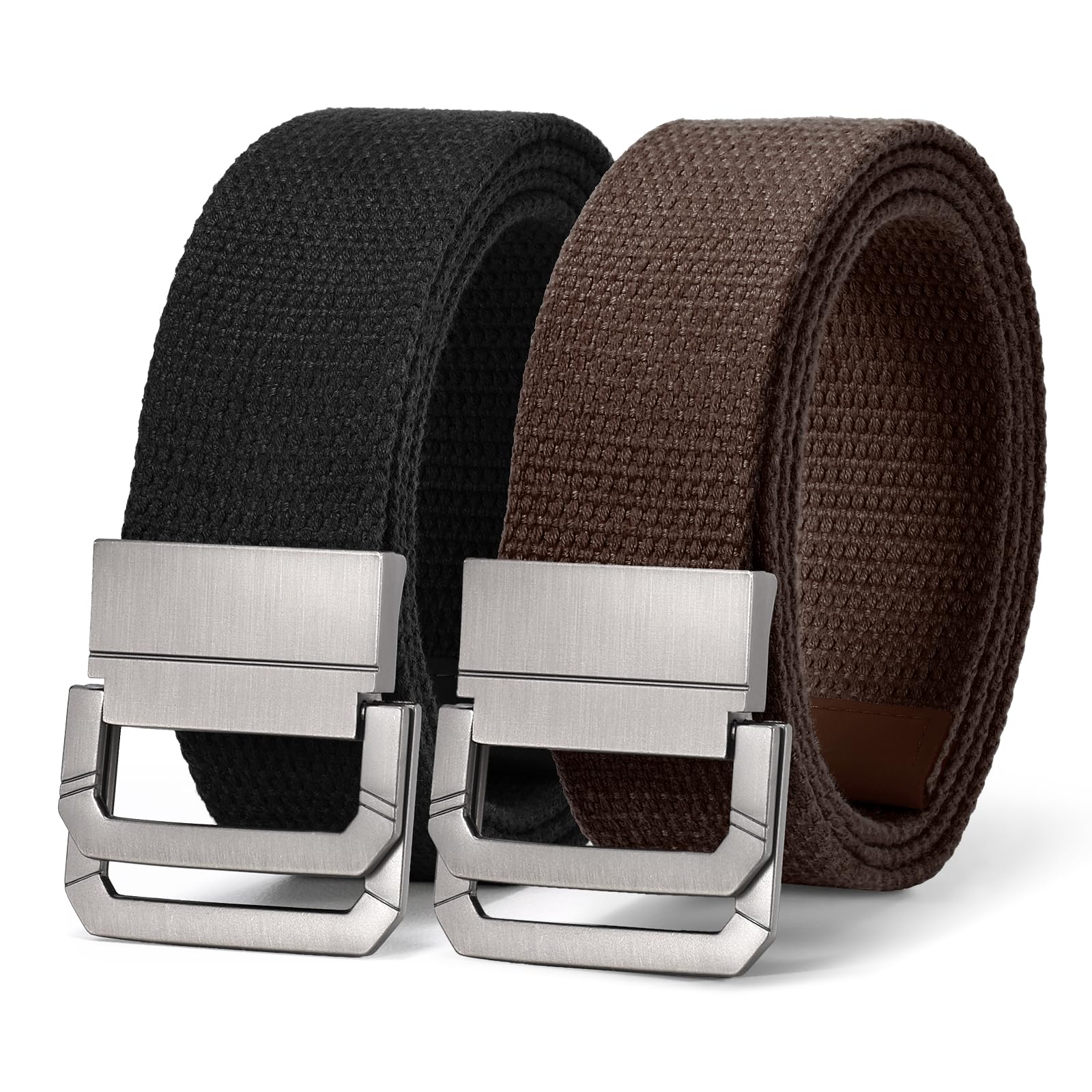
JASGOOD canvas buckles make two paired-front arrangements visible here. The featured square-named product shows black and brown bands with pale straight-edged hardware; the inline double-D gallery shows dark curved fronts in outfits.
One gallery isolates coiled straps on white; the other puts dark curved fronts against clothing. Compare the visible outlines, the crossing band and the setting of each photograph.
In this story
Read the featured JASGOOD canvas buckles in layers
The square-named product portrait places black and brown coiled straps beside each other. Both fronts have pale upper areas and a lower straight-edged frame, with the dark band visible behind parts of the hardware.
Follow the outer side down toward the angled lower corner. That route is more specific than imagining a perfect empty square from the product name.
Use the JASGOOD canvas-belt collection to open these exact entries if the repeated front boundary is the feature you want to compare.
The two colors in the featured photograph belong to that product presentation. They are not proof that every selected pack supplies both pictured straps.
Look separately at the broad pale area above and the lower outlined area. Describing both avoids reducing this particular front to either a bare ring or a single featureless plate.
The double-D gallery shows the front against clothing
The inline gallery collage supplies the actual double-D comparison. A dark curved front appears with a striped polo and blue trousers in one view, and with a light high-neck top and pale trousers in the other.
The front makes a rounded turn beside the band. That curved route contrasts with the straighter sides and angled lower corners visible in the featured square-named product image.
The clothing also changes what can be seen. A trouser loop covers part of the waist arrangement, while the product portrait leaves its coiled straps unobstructed on white.
Do not confuse that change of setting with a hardware measurement. The two gallery formats do not show the objects at the same scale or under matching lighting.
The collage is evidence for the pictured double-D front in those separate outfits. It is not a demonstration of one belt replacing the square-front design on the same wearer.
A frame’s center includes the strap crossing it
Neither comparison should be reduced to an empty geometric outline. Where a band sits behind the front, its color and texture become part of the area enclosed by the hardware.
In the square-named portrait, the dark band contrasts with the pale lower boundary. The adjoining upper face makes another horizontal division within the fastening area.
In the worn double-D views, the dark hardware and strap are closer in tone. Following the curved edge becomes more useful than expecting a bright frame to identify itself.
Compare the route around each visible boundary and the portion left uncovered. Do not complete a hidden second frame from a shadow or a product label.
The useful difference is between these actual straight-edged and curved arrangements. A separate broad plated-front model would introduce a third question rather than complete this pair.

Choose an outline without turning it into a mechanism claim
Suppose you want the front to make a contrasting pale mark against dark webbing. The featured black-and-brown square-named product gives a direct reference for that effect.
If you prefer a dark curved boundary beside the band, the inline double-D outfits show that alternative in context. The curve remains the subject even when the nearby garment partly interrupts it.
Write down the visible side, lower turn and amount of pale surface for the first reference. For the second, note the curved outline and the clothing that frames it.
These notes describe appearance. They do not establish how quickly the front fastens, the force it can hold or whether the two entries share parts.
For a real garment comparison, inspect the selected product’s own worn views rather than assuming the two photographed arrangements expose the same amount of hardware.
Keep inconsistent wording attached to its exact page
Before selecting, read the square-named page and the double-D page separately.
The square-named entry also uses D-ring wording in its descriptive text. That inconsistency is a reason to keep the selected image and option together, not to invent a technical distinction.
Read stated width and size information independently for each entry. The two shape names do not supply dimensions or prove a shared strap composition.
For practical selection beyond this visual question, continue to the buying guides rather than asking the frame outline to establish compatibility.
Compare JASGOOD canvas buckles through the actual square-front product and dark double-D outfit views, keeping their distinct outlines, selected galleries and product identities connected.