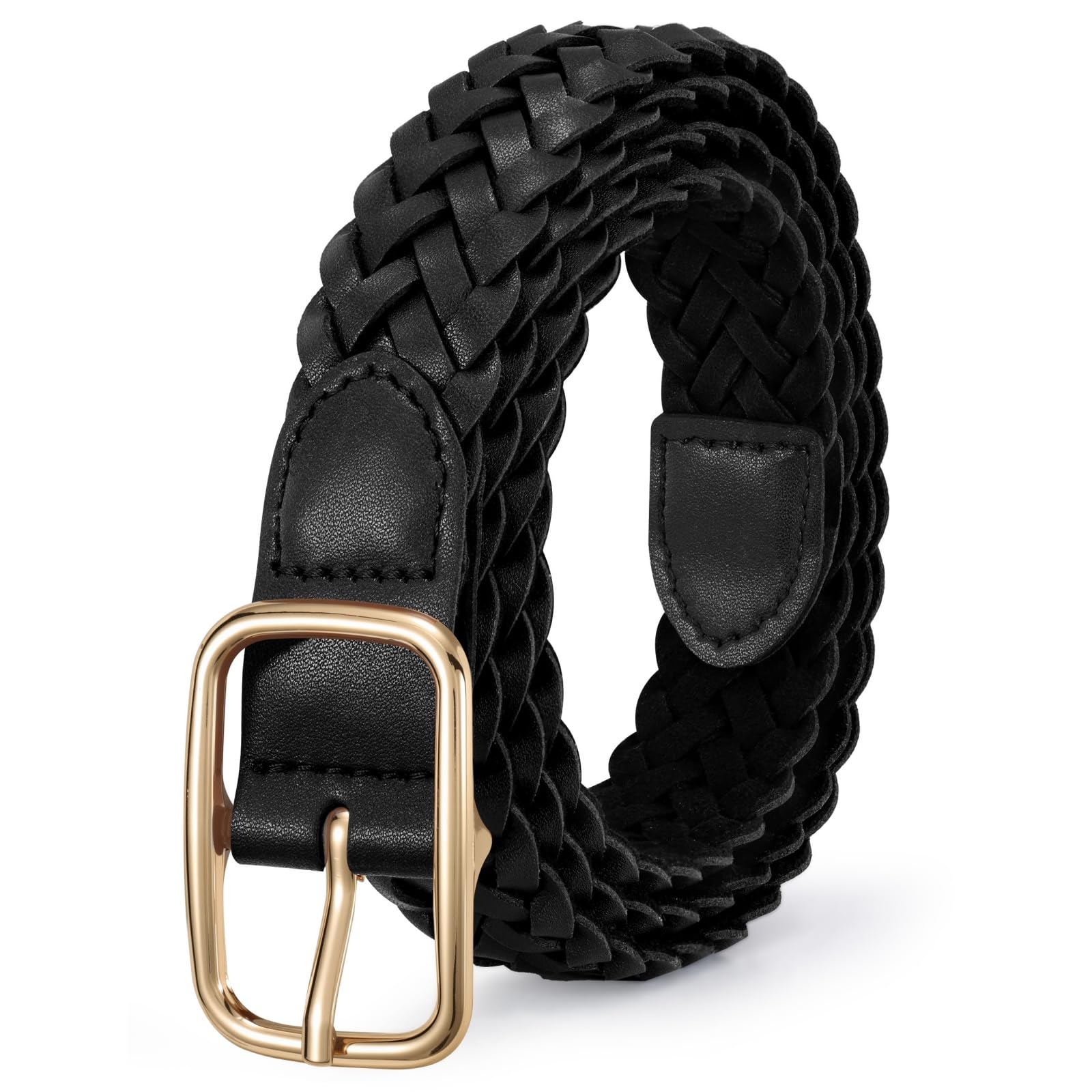
Braided belt adjustment depends on the construction. Some belts are designed for a pin to pass through gaps in the weave; others have dedicated holes or a separate fastening. A braided appearance alone does not establish how to close it.
In this guide
Find the fastening instructions first
Look at the tip, buckle and the section where the pin is shown entering the strap. Ask whether the weave is intended to accept the pin between its strands, or whether only marked openings should be used.
Do not infer permission from a loose-looking gap in a photograph. The pin should not need to break a strand, push through a coating or force an opening wider to create a new adjustment point.
For a stated no-hole example, see JASGOOD’s No-Hole Braided Leather Belts Plus Size. Its listing describes adjustment through the woven construction. Check that model’s size chart separately from other braided belts.
Separate the weave from stretch
A belt can look woven without being elastic. Another may combine braided texture with a stretch construction. Read the material and fit description rather than expecting every braid to expand in the same way.
For an elastic model, use the stated wearing range and the maker’s measuring method. Pulling the loose strap to its maximum length does not tell you how it will feel over trousers during a seated day.
Check the complete route through the trousers
The main braid, finished tip and buckle-end trim may have different widths or thicknesses. Compare the largest section that must pass through the smallest trouser loop.
A weave that fits the loops is only part of the check. The tip should also pass through its keeper normally, and the free end should have somewhere to sit at your chosen setting.
Compare the adjustment you actually need
If preset holes on an existing belt place you between comfortable settings, a design intended to fasten through the weave may offer more choice. Confirm the mechanism instead of assuming a decorative braid solves that problem.
If your main concern is a neat office appearance, compare the texture and buckle with the trousers. A tightly arranged braid may read differently from a chunky casual weave, even when their adjustment method is similar.
Try it without distorting the strands
Follow the product instructions, fasten gently and check that the pin sits in the intended place. Look for stretched, lifted or broken strands around the contact point rather than judging only whether the buckle closes.
Sit and stand, then inspect the fit again. If the belt repeatedly loosens, recheck its route and condition; do not force the pin into a tighter-looking section that was not designed for it.
Choose the braid for both its appearance and its documented adjustment system. That gives you a useful comparison with a conventional hole belt without treating all woven straps as interchangeable.